

3 Core Exercises for Lower Back Pain: Alternatives to Ab Workouts
If sit-ups, Russian twists, or leg raises keep flaring up your lower back, doing more repetitions may not be the answer.
That does not automatically mean your core is weak. It may mean the exercise, range of motion, technique, or current training load does not match what your back can tolerate right now.
Your core is also much more than your abs. It includes muscles around the front, sides, and back of your trunk, along with muscles that work with your hips and pelvis.
In this guide, I’ll show you three core exercises for lower back pain that place more emphasis on the back side of your body:
Supported reverse plank
Chinese plank
Supported reverse plank march
These movements train your glutes, hamstrings, back extensors, and other muscles that help control your trunk. They also give you an alternative when repeated curling or twisting feels uncomfortable.
Why Does My Lower Back Hurt During Ab Exercises?
Lower back pain during an ab workout can happen for several reasons. The exercise may be too difficult for your current capacity, your back may arch or round as you fatigue, or the movement may repeatedly use a direction that already aggravates your symptoms.
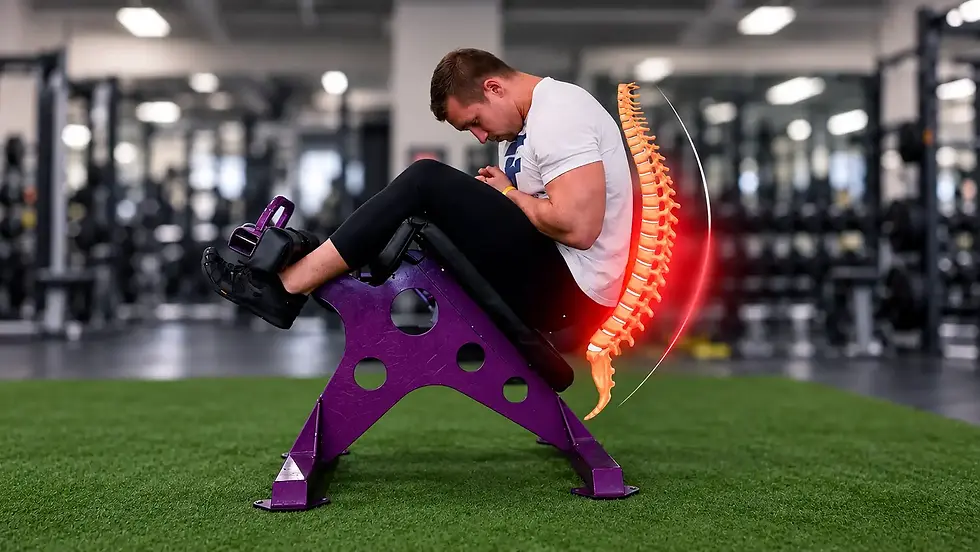
For example, sit-ups and many crunch variations repeatedly bend the trunk forward. Russian twists combine trunk flexion with rotation. Straight-leg raises create a long lever that can become difficult to control.
None of these exercises is automatically harmful, but they may be poorly tolerated during a flare-up or by someone whose pain increases with repeated bending.
Pain during one of these movements does not prove that a disc has been damaged. Low back pain has many possible contributors, and the National Institute of Arthritis and Musculoskeletal and Skin Diseases explains that symptoms can involve the spine, discs, muscles, tendons, ligaments, nerves, and other health factors.
The more useful question is: What happens to your symptoms during the exercise, immediately afterward, and later that day?
If an ab exercise consistently makes your pain sharper, spreads symptoms into your buttock or leg, or leaves you more limited afterward, modify it or pause it instead of forcing more repetitions.
Does a Weak Core Cause Lower Back Pain?
A weak core can be one part of the picture, but it is rarely a complete explanation for low back pain.

Strong athletes, powerlifters, and bodybuilders can still experience back pain, disc-related symptoms, or sciatica. Strength alone does not tell us how well someone tolerates sitting, bending, lifting, rotation, or repeated training volume.
Core training can still be useful. The American Physical Therapy Association’s low-back-pain guideline supports several forms of exercise for chronic low back pain, including trunk strengthening, endurance, movement-control, aerobic, aquatic, and general exercise. The same guideline does not identify one exercise style as superior for everyone.
This is why I do not want you to reduce your entire recovery plan to “my core must be weak.” If you have been doing random core workouts without improvement, read our RehabFix guide on core strength and low back pain before simply adding more volume.
What Muscles Are Part of Your Core?
Your abs are only one section of your core. Your core also includes your obliques, deeper abdominal muscles, spinal muscles, diaphragm, pelvic-floor muscles, hip flexors, and glutes.
Cleveland Clinic’s guide to the core describes this broader system and explains why core strengthening is only one part of managing back pain.
Together, these muscles help you:
Control your trunk as you move
Transfer force between your upper and lower body
Maintain position while you carry or lift
Resist unwanted movement when a task requires stability
Build the endurance needed for work, training, and daily activity
Traditional ab exercises emphasize the front of this system. The three exercises below shift more of the challenge toward the glutes, hamstrings, and muscles along the back of your trunk.
Are Sit-Ups and Crunches Bad for Lower Back Pain?
Sit-ups and crunches are not bad for every spine. Many people can perform them comfortably.

However, they are not mandatory for building a strong core. If they repeatedly reproduce your familiar lower-back or leg symptoms, you can choose a different movement while you improve your capacity.
People with sciatica may need even more care because exercises that include a lot of bending, twisting, or leg tension can affect people differently. Our guide to five core exercises that may aggravate sciatica explains several common triggers and alternatives.
What Are the Best Core Exercises for Lower Back Pain?
There is no universal “best” core exercise for every person with lower back pain. Your best option is one you can perform with control, gradually progress, and recover from without a meaningful increase in symptoms.
These three exercises are useful options when traditional ab workouts feel uncomfortable:
Exercise | Main challenge | Start here |
Supported reverse plank | Glutes, hamstrings, and trunk-extensor endurance | Short two-leg hold |
Chinese plank | Longer-lever posterior-chain endurance | Progress only after the first variation feels controlled |
Supported reverse plank march | Anti-rotation and single-leg hip control | Small, slow alternating marches |
1. Supported Reverse Plank
The supported reverse plank is the starting variation. Your upper back rests on a couch, bed, or stable padded surface while your feet stay on the floor.
How to Perform a Supported Reverse Plank
What Are the Benefits of the Reverse Plank?
This variation can help you:
Train the glutes and upper hamstrings
Build endurance in the muscles along the back of your trunk
Practice hip extension without repeated sit-up motion
Improve whole-body tension from the shoulders through the heels
2. Chinese Plank
The Chinese plank is a more advanced isometric exercise. Both your upper back and your heels are supported, creating a longer lever and a greater demand on the posterior chain.
What Are the Benefits of the Chinese Plank?
The Chinese plank can:
Increase the endurance demand on your glutes, hamstrings, and spinal muscles
Challenge you to maintain a steady trunk position
Train an isometric hold without repeated trunk flexion
Provide a clear progression from the supported reverse plank
3. Supported Reverse Plank March
What Are the Benefits of the Reverse Plank March?
This variation adds:
Single-leg hip stability
Anti-rotation control
Coordination between the hips and trunk
A progression from a static hold to controlled movement
Quality matters more than the number of repetitions. End the set when your hips start dropping or rotating.
How Do You Know if a Core Exercise Is Helping Your Back?
Pay attention to your response instead of judging an exercise only by how difficult it feels.
Before you begin, note where your symptoms are and how a familiar activity feels.
This could be standing from a chair, walking across the room, or bending only as far as is comfortable. Recheck that activity after the exercise and later in the day.
Positive signs may include:
The movement feels steady and controlled
You feel normal muscular effort in the glutes, hamstrings, or trunk
Your usual activity feels the same or easier afterward
You can recover without a meaningful flare-up later that day or the next morning
Stop or regress the exercise if:
Pain becomes sharp or severe
Symptoms spread farther into the buttock, thigh, calf, or foot
Tingling or numbness increases
You notice new weakness
Your pain remains clearly worse after the session
Can These Core Exercises Help a Herniated Disc or Sciatica?
These exercises may help build strength, endurance, and confidence around the spine, but they do not directly diagnose the cause of your pain or guarantee that a compressed nerve has been relieved.
Sciatica can include pain, burning, tingling, numbness, or weakness that travels into the leg. The American Physical Therapy Association’s guide to lumbar radiculopathy explains that exercise selection should match the individual and that bending or twisting exercises may help some people but not others.
If you have a known or suspected disc issue, you can also read our guide to core exercises for disc herniation rehab. Strength training can support recovery, but your plan should also consider your symptoms, movement tolerance, daily demands, and progression back to normal activity.
How Often Should You Do Core Exercises for Lower Back Pain?
There is no perfect dose that applies to everyone. A reasonable starting point is two or three short sessions per week, leaving enough recovery time to judge how your back responds.
Start with the easiest variation. Add only one challenge at a time:
Increase the hold by a few seconds.
Add another controlled set.
Progress from the supported reverse plank to the Chinese plank.
Add a small march while keeping the hips level.
Do not progress duration, sets, and exercise difficulty all at once. The aim is to build capacity over time, not to prove how much discomfort you can tolerate today.
Core work should also be part of a broader activity plan. Walking, general strength training, sleep, daily movement, and gradual exposure to the tasks you want to regain all matter. If you want more movement options, see these three home exercises for lower back pain.
The Missing Piece: The Centralization Process
These three core exercises are excellent starting points, but every case of lower back pain is different.
Some people have disc-related pain.
Others have sciatica.
Some experience joint irritation, while others primarily struggle with muscular dysfunction.
That's why we don't rely on generic exercise programs.
Instead, we use our Centralization Process to identify exactly which movements reduce your symptoms and which movements make them worse.
By observing how your pain responds to specific movements, we can determine whether your symptoms are primarily disc-driven, nerve-driven, joint-related, or muscular. This allows us to build a personalized recovery plan instead of relying on guesswork or random internet exercises.
The goal isn't just helping you survive your current flare-up; it's helping you stop recurring flare-ups altogether.
What Should You Do Next?
If these exercises reduce your pain, that's a strong indication that movement is part of your solution.
However, lasting recovery requires a structured progression- not just doing random exercises whenever your back hurts.
Many of our clients come to us after trying stretching routines, YouTube videos, massage therapy, injections, or rest without lasting results.
What changed their recovery wasn't simply finding another exercise.
It was following the Centralization Process, which helps identify the right movements for their specific condition and progresses those movements over time.
On average, many of our clients experience significant symptom reduction early in the program because they stop guessing and begin following a plan tailored to their spine.
If you're tired of recurring flare-ups, constant stiffness, or living in fear of bending over, consider taking the next step.
✅ See on average a 37% reduction in symptoms in the very first session!
✅ Get a free demo with us following the link below!
Thanks for reading! -Dr. Grant Elliott


Comments