

4 Best Exercise to Strengthen Your Back and Reduce Back Pain
Out of every ten people, around eight will experience low back pain at some point in their lifetime.
And when back pain keeps coming back, many people eventually have the same thought:
“Maybe my back is just weak. I need to strengthen it.”
So they start searching for the best exercise to strengthen your back.
They try stretches. They rest for a few weeks. They see a chiropractor or physical therapist. Then they start doing random back strengthening exercises for lower back pain that they find online.
But sometimes the pain comes back.
And sometimes, the exercises actually make it worse.
Why?
Because getting a stronger back isn't simply about doing more strengthening exercises.
You need to understand what your back can currently tolerate, which movements are appropriate, and when you're ready to increase the load.
Some common low back exercises can flare up a sensitive spine if you aren't prepared for them. That can lead to more fear, more avoidance, and another cycle of pain.
The good news is that strengthening your lower back is an important part of long-term recovery.
You just need to strengthen it the right way.
In this guide, you'll learn four exercises that can help build lower back strength, core stability, hip stability, and movement control, and why strengthening alone may not always be the first step.
Why Your Lower Back May Hurt When You Strengthen It
One of the biggest mistakes people make when dealing with low back pain is completely avoiding load on their spine.
Sometimes this starts after an exercise causes a flare-up.
You try an exercise.
Your pain gets worse.
Then you think:
“Loading my spine must be bad.”
So you stop exercising.
You stop lifting.
You avoid bending.
You avoid squatting and deadlifting.
Eventually, you become even more afraid of using your back.
But that's not necessarily the problem.
Your spine is designed to tolerate force.
The issue may simply be that the amount or type of force you're applying is currently greater than your body is prepared to handle.
The transcript makes this distinction using squats and deadlifts. These exercises aren't automatically bad for your back. However, returning to them before your back is ready can cause a flare-up, which may lead you to incorrectly blame the exercise itself.
That's why the goal isn't to avoid loading forever.
The goal is to gradually build your capacity.
Is the Superman Exercise Bad for Your Lower Back?
The Superman exercise is one of the most commonly recommended lower back strengthening exercises you'll find online.
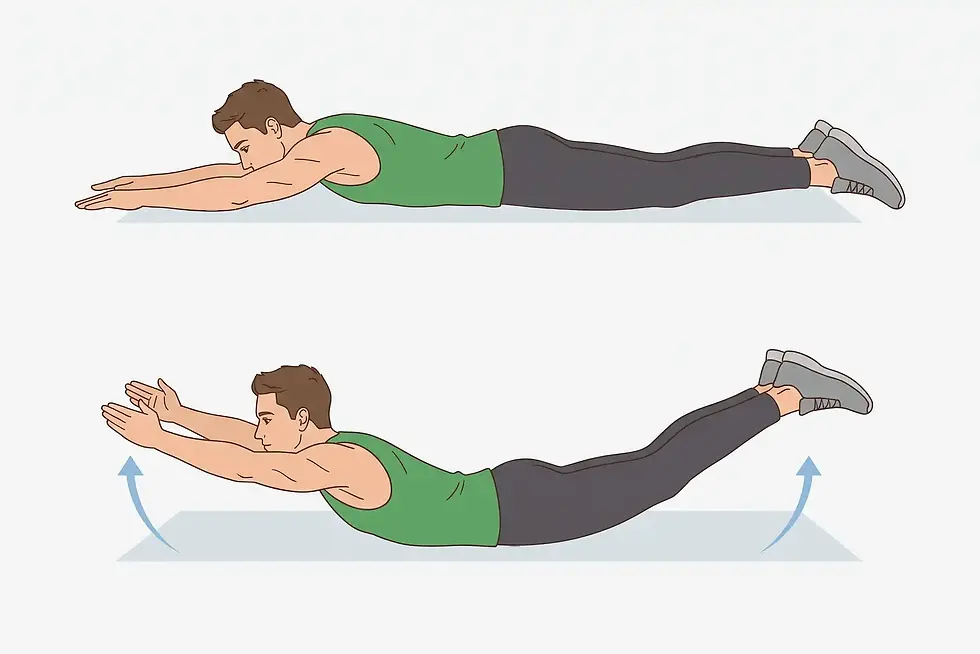
But it isn't necessarily the best starting point for someone with a sensitive back.
The transcript discusses older research from Dr. Stuart McGill that measured substantial compressive force during the Superman exercise. Importantly, the video also clarifies that this is older evidence and that spinal compression itself isn't automatically harmful.
The bigger lesson is:
An exercise can be useful and still be inappropriate for you at a particular stage of recovery.
If your back isn't prepared for the amount of force being produced, a movement like the Superman may flare your symptoms.
And when that happens, people often respond by:
Stopping exercise
Avoiding spinal loading
Resting for long periods
Becoming afraid of movement
That's how a simple flare-up can turn into a long-term cycle.
Strength and Stability Are Not the Same Thing
When people search for a lower back strengthening routine, they often focus only on making the spinal muscles stronger.
But strength isn't the whole picture.
You also need to control your spine while your arms and legs move.
You need to stabilize your trunk while walking.
You need to maintain control while carrying weight.
And eventually, you need to control your spine while hinging, squatting, deadlifting, and performing other demanding movements.
That's why an effective back strengthening exercise routine should eventually train:
Strength
Stability
Coordination
Hip control
Core control
Movement under load
The four exercises below are designed around those qualities.
4 Best Exercises to Strengthen Your Back
Exercise 1: Bird Dog
The Bird Dog is a classic exercise for improving spinal stability, coordination, and lower back control.
It's not designed to give you the biggest spinal erectors or glutes possible.
Instead, it teaches your body how to control the spine while your arms and legs move.
That makes it a useful starting point in a lower back strengthening routine, particularly when your goal is to learn how to control your spine before progressing to heavier loads.
Why It Helps
The Bird Dog can help improve:
Core stability
Lower back control
Spinal coordination
Hip stability
Glute control
Movement quality
One of the key cues from the video is to expand your abdomen rather than simply tightening your stomach inward. This creates internal abdominal pressure while helping you maintain control of the spine.
The goal isn't to move your arm and leg as far as possible.
The goal is to keep the spine controlled while the limbs move.
Exercise 2: Dead Bug
The Dead Bug is another excellent exercise to strengthen your back indirectly by improving core and spinal stability.
Instead of loading the lower back directly, you're training your ability to maintain a stable lumbar position while your arms and legs move.
Why It Helps
The Dead Bug can help develop:
Core stability
Abdominal control
Lumbar stability
Coordination
Control during limb movement
Better preparation for loaded exercise
The Bird Dog trains similar stability from the back side of the body, while the Dead Bug challenges the front side.
Together, they teach you how to maintain control around your spine while your limbs move.
Because of that, the Dead Bug can also work well as part of a lower back strengthening routine or warm-up before training.
Exercise 3: Farmer's Walk
Now we're going to introduce actual external load.
The Farmer's Walk, also called a farmer carry, is one of the simplest ways to challenge your entire body while carrying weight.
This is important because one common misconception is that putting load through the spine is automatically damaging.
It isn't.
Your body needs exposure to load to build capacity.
The transcript emphasizes that progressively loading the spine can be part of developing strength and resilience rather than something that should always be avoided.
Why It Helps
Farmer's Walks can train:
Lower back endurance
Core stability
Upper back strength
Shoulder strength
Hip stability
Trunk control
You're also constantly shifting from one foot to the other as you walk, creating an additional challenge for your hips and spine.
This makes loaded carries an excellent progression when you're ready to move beyond basic floor-based strengthen low back exercises.
Exercise 4: Romanian Deadlift
The fourth exercise is the Romanian Deadlift, or RDL.
If your goal is to build a strong lower back and eventually return to lifting, learning how to hinge properly is essential.
A good hip hinge allows you to train the:
Hamstrings
Glutes
Lower back
while keeping your movement controlled.
The RDL is therefore an excellent movement for rebuilding your ability to load your posterior chain.
Are Squats and Deadlifts Bad for Your Back?
No, not automatically.
Squats and deadlifts are some of the most effective movements for developing strength through your:
Legs
Glutes
Lower back
Posterior chain
But they also create significant demands on your body.
If you aren't prepared for those demands, returning to heavy squats or deadlifts too quickly may trigger a flare-up.
That doesn't mean the exercises are bad.
It means your current capacity doesn't yet match the demand.
The right strategy is to build capacity gradually so you can eventually return to the movements you want to perform.
How to Build a Lower Back Strengthening Routine
A good lower back strengthening routine shouldn't be based on doing the hardest exercise you can tolerate.
You want to progress gradually.
A simple progression from this routine can look like:
Bird Dog → Dead Bug → Farmer's Walk → Romanian Deadlift
The first two exercises focus heavily on coordination and stability.
The Farmer's Walk introduces loaded movement.
The RDL then introduces a controlled hip hinge under resistance.
As your strength and movement capacity improve, you may eventually be ready to progress toward:
Squats
Deadlifts
Heavier carries
Athletic movements
More demanding strength exercises
This is how you move from basic back strengthening exercises for lower back pain toward full-body strength and resilience.
Why Getting Stronger Doesn't Always Fix Back Pain
Here's something very important.
You can perform all four of these exercises correctly and become much stronger.
But your back pain might still be there.
Why?
Because strengthening may not be the first problem you need to address.
There could be another factor driving the pain.
For example:
A disc bulge
Nerve irritation
Hip mobility limitations
A movement-related issue
The transcript specifically explains that the four strengthening exercises are valuable during the bulletproofing phase, but they may not address the underlying problem if you're not ready for that stage yet.
That's one of the most important concepts in back pain rehabilitation.
Pain Reduction First, Bulletproofing Second
Think about your recovery in two phases.
Phase 1: Pain Reduction
Before aggressively strengthening your back, you may first need to:
Reduce irritation
Restore comfortable movement
Address disc-related symptoms
Reduce nerve sensitivity
Find movements your body responds to
Phase 2: Bulletproofing
Once your symptoms are better controlled, you can progressively build:
Lower back strength
Core stability
Hip strength
Load tolerance
Movement confidence
Athletic capacity
That's where the four exercises in this article become especially useful.
You don't have to choose between pain relief and strength.
You need to know when each phase is appropriate.
Why Random Back Strengthening Exercises Don't Work
One of the biggest mistakes people make is searching:
“Exercise to strengthen your back”
and simply doing the first few movements they find online.
But successful rehabilitation isn't about finding the longest list of exercises.
It depends on:
Proper exercise selection
Correct timing
Appropriate loading
Symptom response
Movement quality
Progression
An exercise that works extremely well for one person may not be the right starting point for another.
So if a strengthening exercise makes your symptoms worse, don't automatically assume:
“My back is too weak.”
It may simply mean:
“I'm not ready for this movement or load yet.”
Don't Just Get Stronger, Build a Back That Can Handle Life
Getting stronger is important.
But your ultimate goal shouldn't be to become good at four exercises.
You want a back that can handle the demands of your actual life.
That means eventually being able to:
Bend
Lift
Carry
Squat
Hinge
Walk
Run
Train
Play sports
without constantly worrying that one wrong movement will hurt you.
The transcript describes this transition as moving from pain reduction into a bulletproofing phase, where you rebuild strength, movement, and capacity for long-term function.
What Should You Do Next?
If these exercises help you feel stronger or move better, that's valuable information.
But if you have persistent lower back pain, simply adding more strengthen low back exercises may not be the answer.
You first need to understand what's actually driving your symptoms and whether your body is ready for the strengthening phase.
Many of our clients come to us after trying stretching, YouTube exercises, rest, and different treatments without lasting results.
What they were missing wasn't another random exercise.
It was the right plan for their specific situation.
That's why we use the Centralization Process to determine what needs to be addressed first, which movements are appropriate, and how to progress from pain reduction into the strengthening and bulletproofing phase.
Our clients see an average 37% reduction in symptoms in a single session, while some have completely eliminated their pain within as little as 15 days. These are reported client outcomes, and individual results vary.
If you're tired of recurring back pain, avoiding the gym, or constantly wondering which back strengthening exercises for lower back pain are actually right for you:
✅ See on average a 37% reduction in symptoms in the very first session!
✅ Get a free demo with us following the link below!
Stop guessing and start following a structured plan designed around your specific back.
Thanks for reading!– Dr. Grant Elliott


Comments