

5 Core Exercises Making Your Sciatica Worse (And What To Do Instead)
If you are dealing with Sciatica, there is a very good chance that some of your current core exercises are actually making your symptoms worse instead of helping you recover.
Unfortunately, many people with:
Lower back pain
Sciatic nerve irritation
Nerve tension
are repeatedly told to “strengthen the core” without understanding WHICH exercises are safe for a sensitive spine.
This is a major problem.
Because while improving core strength absolutely matters, the wrong movements can:
Increase disc pressure
Irritate the sciatic nerve
Increase inflammation
Trigger flare-ups
Delay healing
Today, we are going to break down:
5 common core exercises that may worsen sciatica
Why these movements aggravate the spine and nerves
Better exercise alternatives
Safe ways to build core stability without increasing pain
These are the same principles we use every day with clients inside the RehabFix Online Low Back Program.
What Is Sciatica?
Before discussing exercises, it is important to understand what Sciatica actually is.
Sciatica refers to pain that radiates along the pathway of the sciatic nerve, which is the largest nerve in the human body.
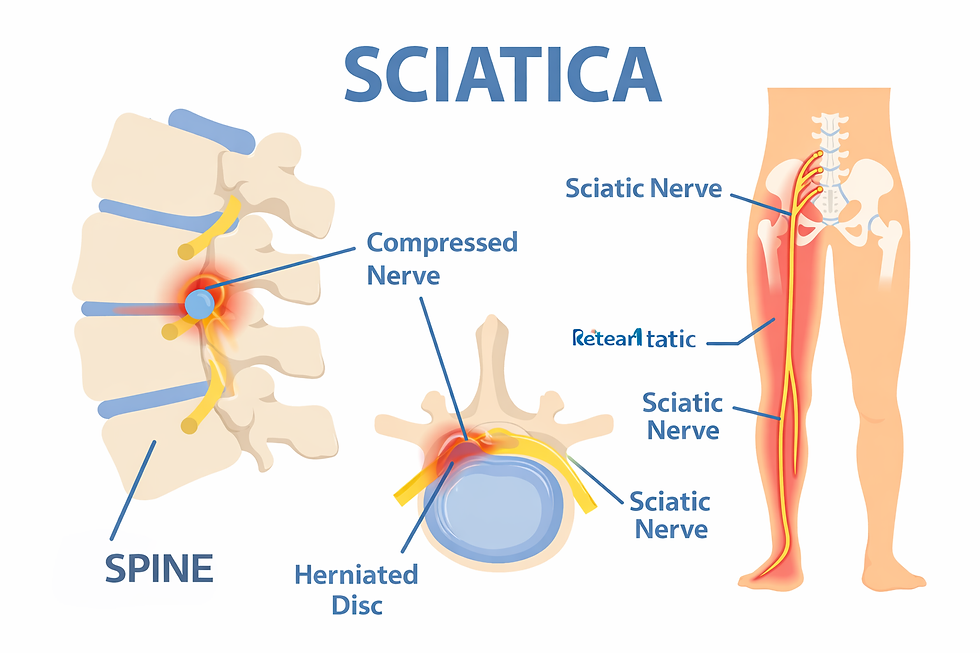
Symptoms commonly travel through the:
Lumbar spine
Gluteal region
Hamstrings
Calf
Foot
The most common causes include:
Lumbar disc herniation
Disc bulges
Nerve root irritation
Neural inflammation
The spinal levels most commonly involved are:
When these structures become irritated, the surrounding neural tissue becomes highly sensitive to:
Compression
Stretch
Flexion
Rotation
This is why certain exercises can dramatically increase symptoms.
Why Some Core Exercises Make Sciatica Worse
One of the biggest misconceptions in rehab is that all core exercises are automatically good for back pain.
They are not.
Many traditional ab workouts involve:
Excessive spinal flexion
Loaded rotation
Increased neural tension
Poor lumbar stabilization
For a healthy spine, these movements may be tolerated well.
But for someone with:
Disc pathology
Nerve irritation
Acute sciatica pain
these same exercises may become extremely aggravating.
1. Traditional Crunches Exercise:
Traditional crunches exercise variations are one of the most common aggravators for sciatica sufferers.
Whether performed:
On the floor
On a decline bench
Using gym machines
During high-repetition ab circuits
…the mechanical stress is often the same.
Why Crunches Can Increase Sciatica Pain:
During crunches, the lumbar spine repeatedly moves into:
👉 spinal flexion.
Research consistently shows that flexion increases:
Intradiscal pressure
Posterior disc loading
Stress on the annulus fibrosus
If you already have a sensitive disc bulge, this repetitive flexion may:
Increase disc protrusion
Irritate the nerve root
Increase sciatic nerve sensitivity
This is why many individuals notice:
More back stiffness
Increased leg pain
More nerve symptoms after crunches
Especially in the acute stages of sciatica.
2. Straight Leg Raises:
The next movement that commonly aggravates symptoms is the straight leg raises exercise.
Why Straight Leg Raises Can Irritate the Sciatic Nerve
This movement significantly increases:
👉 neural tension.
In orthopedic assessment, there is a test called the:
This test intentionally increases tension through the:
Sciatic nerve
Hamstrings
Neural pathways
When you perform straight leg raises, you create a very similar tension mechanism.
The combination of:
Extended knees
Hip flexion
Lever arm loading
places substantial stress on sensitive neural tissue.
For many people with sciatica, this creates:
Burning pain
Pulling sensations
Hamstring tightness
Increased nerve irritation
This is one of the biggest reasons people feel worse after aggressive abdominal workouts.
3. Russian Twist Exercise:
The russian twist or russian twist exercise is another movement that commonly aggravates lumbar disc injuries.
Why Russian Twists Can Be Dangerous
This movement combines:
Spinal flexion
Rotation
External load
This combination is one of the most common mechanisms associated with:
Disc bulges
Annular tears
Lumbar irritation
A sensitive lumbar disc often struggles to tolerate rotational stress.
During russian twists, rotational forces increase stress through:
The annulus fibrosus
Lumbar vertebrae
Intervertebral discs
Neural tissues
This can increase:
Sciatica pain
Low back stiffness
Nerve sensitivity
Especially if symptoms are already acute.
4. Hanging Leg Raises:
Hanging leg raises are another highly provocative movement for many individuals with sciatica.
Why Hanging Leg Raises Increase Symptoms
This exercise commonly increases:
Lumbar flexion
Disc pressure
Nerve tension
Many individuals also unintentionally turn this into a:
👉 toes-to-bar style movement.
This creates:
Excessive spinal flexion
Poor lumbar control
Increased compression on sensitive structures
The result is often:
Increased stiffness
Nerve pain
Sciatic flare-ups
after training.
5. Superman Exercise:
The Superman exercise is more controversial.
Some individuals tolerate it well…
…but others feel significantly worse afterward.
Why Superman Exercises Can Flare Up Sciatica
The Superman movement places the lumbar spine into aggressive:
👉 lumbar extension.
Although extension can help some disc injuries, excessive active extension may aggravate others.
Especially individuals with:
Extension intolerance
Facet joint irritation
Posterior element compression
Sensitive neural tissue
This can create:
Lower back tightness
Compression sensations
Increased nerve pain
Spinal stiffness
after exercise.
Better Core Exercises for Sciatica
Now that we covered what NOT to do…
Let’s discuss safer movements that help improve:
Core stability
Lumbar control
Glute activation
Spinal endurance
without aggravating the sciatic nerve.
1. Curl-Ups:
Curl-ups are often much better tolerated than traditional crunches.
Why Curl-Ups Work Better
Unlike crunches, curl-ups help maintain:
A more neutral lumbar spine
Reduced flexion stress
Better spinal positioning
This helps reduce:
Intradiscal pressure
Nerve irritation
Mechanical stress on lumbar discs
For many individuals with sciatica, curl-ups feel significantly more comfortable.
2. Reverse Crunches Exercise:
A reverse crunches exercise or reverse crunch exercise is often a much safer substitute.
Reverse Crunch Benefits:
One of the biggest reverse crunch benefits is that the knees remain bent during the movement.
This helps:
Reduce neural tension
Improve lumbar control
Shorten the lever arm
Reduce stress on the lower back
Because the legs remain bent, there is less pull on the sciatic nerve.
This makes the movement much more tolerable for individuals with:
Disc herniation
Sciatica
Nerve irritation
Additionally, reverse crunches workout variations can still create excellent abdominal activation without excessively stressing the spine.
3. Controlled Knee Raises:
Instead of straight hanging leg raises:
👉 use bent-knee raises.
Why Bent-Knee Raises Work Better
Keeping the knees bent helps:
Reduce leverage
Reduce nerve tension
Improve pelvic control
Minimize lumbar flexion
You can still develop excellent core strength while reducing irritation to the spine and nerves.
4. Bird Dog Exercise :
The Bird Dog is one of the best exercises for spinal stability and low back rehabilitation.
Bird Dog Exercise Benefits:
The bird dog exercise benefits include:
Improved spinal stability
Better balance
Enhanced glute activation
Increased deep core engagement
Improved neuromuscular coordination
This movement activates important stabilizers such as:
Unlike aggressive extension exercises, Bird Dogs improve spinal control without placing excessive stress on the lumbar discs.
Why The Right Exercise Depends On Your Specific Problem
This is extremely important.
Not every person with sciatica responds the same way.
Some people are sensitive to:
Flexion
Extension
Rotation
Neural tension
Others are not.
This is why random YouTube exercise programs often fail.
Successful rehab depends on:
Your symptoms
Your movement response
Your disc sensitivity
Your neural irritability
The RIGHT exercise at the WRONG time can still make you worse.
The Missing Link: The Centralization Process
At this point, you can probably see something important…
Recovery is not about randomly stretching or strengthening.
It’s about finding:
👉 the RIGHT movement for YOUR spine.
This is exactly why we use the:
👉 Centralization Process
This process helps determine:
Which movements reduce symptoms
Which movements aggravate symptoms
How your discs and nerves respond to motion
This allows us to build a plan tailored specifically to YOUR body.
What Is the Next Step?
This can vary from person to person, but in my experience working with clients worldwide, there is a consistent pattern among individuals dealing with sciatic nerve pain, disc herniation, and persistent symptoms.
They’ve tried everything…
But they’re missing one key component:
✅ What they were missing is the Centralization Process which helps us immediately determine the right exercises for your situation!
✅ See on average a 37% reduction in symptoms in the very first session to avoid surgery!
✅ Get a free demo with us following the link below!
Thanks for reading! -Dr. Grant Elliott


Mình hay lướt soi cầu miền Bắc mỗi ngày trước giờ quay, chủ yếu để có thêm dữ liệu tham khảo chứ không dám tin tuyệt đối. Trên site này mình thích nhất mấy phần thống kê kiểu lô gan với mục “lô đẹp hôm nay”, nhìn nhanh là thấy nhịp số nào đang được nhắc nhiều. Bài viết cũng chia theo ngày khá rõ, ví dụ đúng hôm 16 8 2026 là có block soi cầu MB riêng nên khỏi phải mò. Mình thường đọc xong rồi tự chốt lại theo kiểu bạch thủ cho gọn, thỉnh thoảng mới ngó thêm lô xiên cho vui. Giao diện cuộn xuống là thấy các mục dự đoán xếp thành từng khối…
Mình mua vé số chủ yếu cho vui thôi, coi như thêm chút hồi hộp cuối ngày; trúng thì mừng, còn không trúng cũng chẳng áp lực gì. Trước đây nghe bạn bè bàn chuyện “cầu” với “kèo” rôm rả nên mình cũng thử tìm hiểu, mà mới đầu thấy loạn cả lên. Theo dõi một thời gian, mình bắt đầu ghi lại vài nhận định mình thấy hay bị lặp, rồi đem so với kết quả để tự kiểm tra xem có phải mình đang tự hợp lý hóa không. Thỉnh thoảng mình lướt soicauxsmb.io để có thêm chuyện tám với tụi bạn, nhưng luôn nhắc bản thân là chỉ tham khảo cho vui. Có hôm trúng chút đỉnh…