

Tight Hips Causing Lower Back Pain? Relieve It With This 1 Simple Exercise
If your hip is tight and your lower back pain just won’t go away… this might be the missing link.
A question I hear all the time is: Why are my hips so tight?
And more importantly…
👉 Can tight hips and glutes cause lower back pain?
The answer is YES, and it happens more often than you think.
What Causes Tight Hips?
Let’s first answer the big question: what causes tight hips?
Most people develop hip tightness due to:
Prolonged sitting
Lack of movement through full range of motion
Weak gluteal muscles
Poor hip joint mobility
Limited internal rotation and hip extension
Over time, this leads to chronic tightness in hips and reduced movement efficiency.
Signs of Tight Hips You Shouldn’t Ignore
How do you know if this is your issue?
Here are common signs of tight hips:

Difficulty squatting deeply
Feeling stiffness in the hip joint
Restricted movement during walking or running
Tight glutes and hips during daily activity
Pain when sitting for long periods
Many people also experience tight hip adductors or tight hip adductor muscles, especially if they’ve been inactive.
How Tight Hips Cause Lower Back Pain
Now let’s connect the dots between lower back pain and tight hips.
When your hips don’t move properly:
Your lumbar spine compensates
Your intervertebral discs take on extra load
Your paraspinal muscles overwork
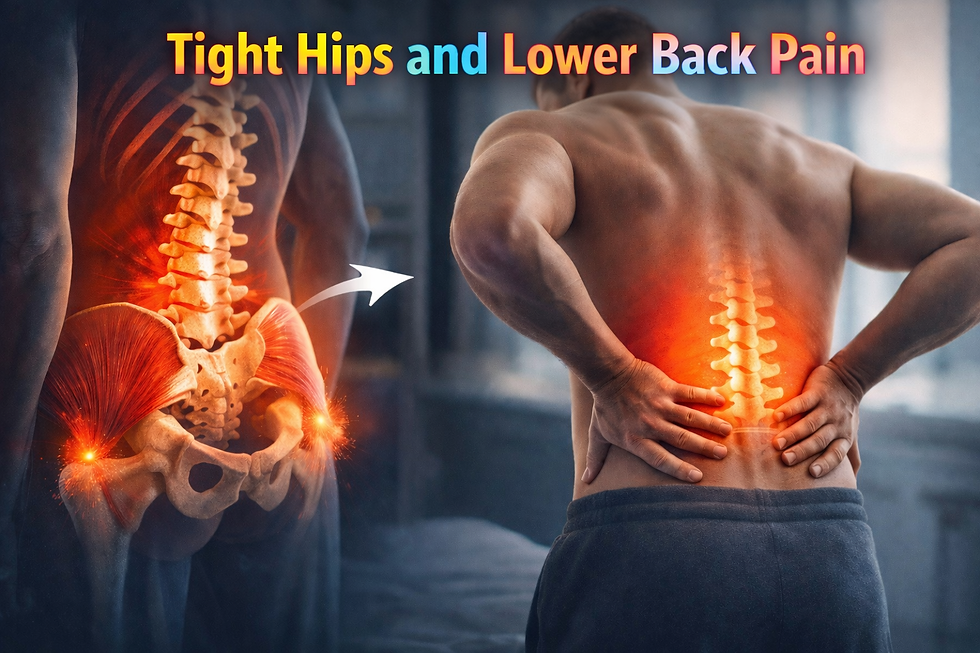
This leads to hip tightness and lower back pain developing together.
👉 This is one of the most common tight hips causes of chronic back pain.
So yes, can tight hips and glutes cause lower back pain?
Absolutely.
The Compensation Problem (Why It Gets Worse)
Imagine trying to squat with restricted hips.
Your body still needs to move…
So your lumbar vertebrae take over.
This creates:
Increased spinal stress
Reduced hip mobility
Chronic compensation patterns
Over time, this leads to pain that just won’t go away.
The BEST Exercise for Tight Hips
If you’re looking for exercises for tight hips, this is one of the most effective.
Frog Mobilization:
Start in a quadruped position
Spread knees wide
Keep ankles in dorsiflexion
Maintain a neutral lumbar spine
Rock hips back and forth
Why This Works
This exercise improves:
Hip adductor mobility
Capsular mobility of the hip joint
Synovial fluid production
Neuromuscular control
👉 It directly targets tight hip adductors and improves movement.
Advanced Exercise: Tactical Frog
If you want more advanced exercises for tight hips and lower back pain, this is a game-changer.
Tactical Frog:
Start in frog position
Rock backward
As you move forward, rotate one hip internally
Alternate sides
Benefits
This movement:
Trains internal rotation
Activates glutes and hip flexors
Improves joint control
Reduces tightness in hips
👉 It’s one of the best movements for long-term mobility.
Why Most People Stay Tight
Most people never train their hips properly.
They:
Avoid full range of motion
Never load end-range positions
Sit for long periods
This leads to:
Chronic hip tightness
Weak stabilizers
Ongoing compensation
Important: This Is Only Part of the Solution
Even the best exercises for tight hips won’t fully fix your pain if the root issue is in your lower back.
If you have:
Nerve root irritation
👉 Then your lumbar spine still needs to be addressed.
What Your Spine Actually Needs to Heal (The Missing Link)
At this point, you can see it’s not just about stretching or doing random mobility work.
It’s about understanding how your lumbar discs, nerve root, and movement patterns interact and applying the right strategy at the right time.
Because doing the wrong thing ,even a good exercise, can keep you stuck.
What Is the Next Step?
This can vary from person to person, but in my experience working with clients worldwide, there is a consistent pattern among individuals dealing with lower back pain and tight hips.
They’ve tried everything…
But they’re missing one key component:
✅ What they were missing is the Centralization Process which helps us immediately determine the right exercises for your situation!
✅ See on average a 37% reduction in symptoms in the very first session to avoid surgery!
✅ Get a free demo with us following the link below!
Thanks for reading! -Dr. Grant Elliott


Comments