

Sciatica Gets Worse When Sitting? Why It Happens & 3 Ways to Help
If your sciatica gets worse every time you sit down, especially when you're working at a desk, driving, or relaxing on the couch, there's a reason you may be experiencing this pattern.
You might notice that your leg pain gradually increases after sitting for 30 minutes or an hour. When you finally stand up, your lower back feels stiff, your buttock hurts, and the pain may travel farther down your leg.
But here's something important: sitting itself isn't necessarily the problem. The position you're sitting in, how long you stay there, and how much you move throughout the day can all influence your symptoms.
One common position that may aggravate sciatica is slumped sitting.
When you slump, your pelvis tends to rotate backward, and your lower back moves into a more rounded position. For people whose symptoms are sensitive to forward bending, this position may make their lower-back or leg pain worse.
The good news is that you can make a few practical changes to your sitting position and introduce exercises that help you work on hip and lower-back mobility.
In this article, I'll explain why sciatica gets worse when sitting and show you three steps that may help you improve your sitting comfort and movement.
Why Does Sciatica Get Worse When Sitting?
To understand why sitting can make sciatica worse, we need to look at what's happening around your pelvis and lower back.
Your pelvis and lumbar spine work together whenever you sit, stand, bend, or walk.
However, when you spend several hours sitting in a slumped position, your body may gradually move into a posture that some people with lower-back-related sciatica find uncomfortable.
Let's break down what's happening.
1. Your Pelvis Rolls Backward When You Slouch
When you sit on a soft couch, a car seat, or an office chair without enough support, your pelvis may gradually roll backward.
This movement is called posterior pelvic tilt.
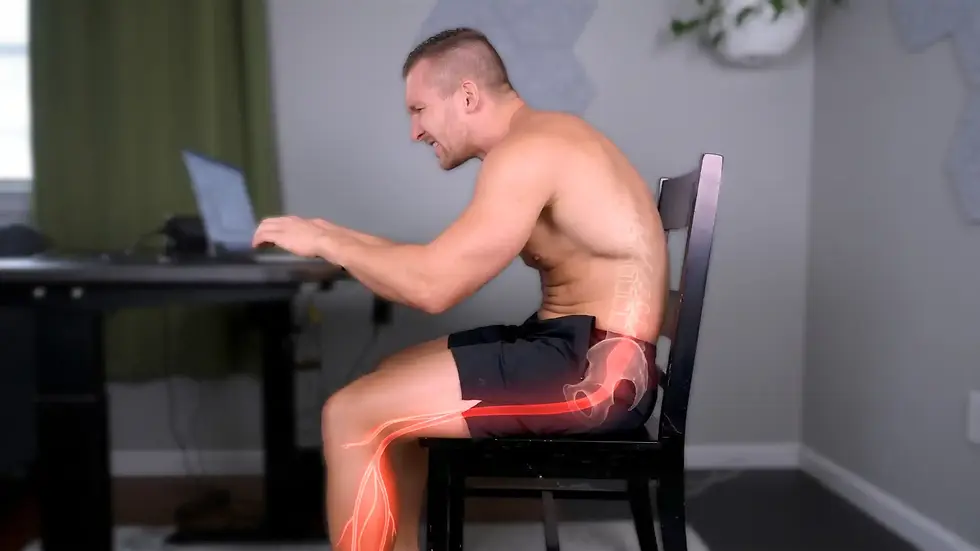
As your pelvis rotates backward, your lower back tends to lose some of its natural inward curve and move into a more flexed or rounded position.
You might notice this when:
Your hips slide forward in your chair.
Your lower back becomes rounded.
Your shoulders fall forward.
You lean back into a soft couch.
You sit for long periods without changing positions.
This is especially relevant if your lower-back symptoms are sensitive to repeated or prolonged forward bending.
2. Your Lower Back Moves Into Flexion
Your lumbar spine has a natural curve that changes depending on your sitting position.
When you slump, your lower back generally moves toward flexion, meaning it becomes more rounded.
For some people with disc-related back pain or sciatica, sustained flexed positions can aggravate symptoms.
Lumbar flexion changes how forces are distributed through your spinal structures. If a nerve root is already irritated, certain positions may increase your discomfort.
However, this doesn't mean every person with sciatica should avoid bending or that sitting in a rounded position automatically causes a disc herniation.
The important factor is how your symptoms respond to that position.
3. Your Hips Remain in a Flexed Position for Too Long
There is another movement restriction worth considering: hip extension.
When you sit, your hips remain bent, usually with your thighs positioned in front of your body.
If you spend most of the day in this position and rarely move your hips into extension, you may find that extending your hips comfortably becomes more difficult.
Hip extension is important for walking, running, standing upright, and many everyday movements.
Improving your ability to move your hips through comfortable ranges may help you perform these activities more efficiently.
This doesn't mean sitting permanently shortens your hip flexors or that limited hip extension is the cause of every case of sciatica. It is simply one area worth assessing when you're dealing with recurring lower-back and leg symptoms.
Is Sitting Bad for Sciatica?
You've probably heard the statement that sitting is the new smoking.
But sitting isn't automatically harmful.
What matters is how long you sit, the positions you use, how frequently you change positions, and what you do outside your sitting hours.
For example, someone who sits for work but regularly walks, exercises, and changes positions throughout the day has a different overall activity pattern from someone who spends nearly the entire day sitting with very little movement.
The NHS recommends staying active and avoiding long periods of sitting or lying down when managing sciatica. Read the NHS guidance on sciatica.
You don't need to eliminate sitting from your life. Instead, focus on making sitting more comfortable and introducing regular movement into your day.
How to Relieve Sciatica When Sitting: 3 Steps to Try
If sitting aggravates your sciatica, I would start by addressing your sitting position before adding more complicated exercises.
The following three steps focus on lumbar support, active hip extension, and lumbar extension.
They may help people whose symptoms respond favorably to these positions and movements. However, extension-based exercises are not appropriate for everyone with sciatica.
Step 1: Fix Your Sitting Position With Lumbar Support
The first thing you can change is the position of your lower back while sitting.
If your pelvis rolls backward and your lumbar spine becomes rounded, adding appropriate lumbar support may help you maintain a more comfortable sitting position.
You don't need an expensive ergonomic chair to try this.
A small lumbar cushion or a rolled-up towel can be enough.
How to Use Lumbar Support While Sitting
Sit in your normal office chair, car seat, or another stable sitting surface.
Take a small towel and roll it into a comfortable shape.
Place it behind your lower back, around the natural inward curve just above your pelvis.
Adjust the towel until it supports your lower back without forcing it into an exaggerated arch.
Keep your feet supported and find a comfortable position for your hips and knees.
Notice whether the additional support makes sitting more comfortable.
You can also use an adjustable lumbar cushion designed for an office chair or car seat.
Why Lumbar Support May Help
A lumbar support helps maintain the natural curve of your lower back while sitting.
For some people, this reduces the tendency to slump into a position that aggravates their symptoms.
It can also serve as a simple reminder to change your sitting position instead of allowing your pelvis to slide forward throughout the day.
However, lumbar support is not a permanent fix for sciatica. It doesn't guarantee that pressure has been removed from a spinal nerve or that a disc herniation has been corrected.
My tip: Don't keep the support in place if it becomes uncomfortable. Remove it temporarily, change your position, and take a short movement break before using it again.
The goal is not to hold one perfect posture all day. It's to find comfortable positions and avoid staying in the same position for too long.
Step 2: Prone Hip Extensions
The next exercise focuses on your hips.
When you sit for several hours, your hips remain in a flexed position. This exercise introduces active hip extension by having you lift your leg behind your body while lying on your stomach.
Unlike a passive hip flexor stretch, you're actively moving your hip and using your glute muscles.
How to Perform Prone Hip Extensions
Lie on your stomach on a comfortable surface.
Extend your arms out to your sides for support.
Keep both legs straight.
Gently engage your glutes and raise one leg off the surface.
Lift your heel toward the ceiling without twisting your pelvis.
Lower your leg slowly.
Repeat with the opposite leg.
Continue alternating sides using controlled movements.
The goal is to move your hip into extension without excessively arching your lower back.
You don't need to lift your leg extremely high. Use the range you can control comfortably.
Suggested starting volume: The video recommends at least 10 repetitions per side, performed in the morning and evening.
If you have difficulty maintaining control or feel your lower back taking over, reduce the height of the leg lift.
Why Prone Hip Extensions May Help
This exercise works on active hip extension while engaging the gluteal muscles.
It allows you to practice a movement that is different from the hip-flexed position you spend much of your sitting time in.
It also requires some control from your lower-back muscles and pelvis.
Over time, appropriate active mobility and strengthening work may help improve your ability to extend the hip during walking and other daily activities.
My tip: Keep your pelvis stable. If lifting your leg causes your lower back to arch excessively or increases your sciatica, reduce the movement or stop.
Step 3: Prone Press-Ups for Lower-Back Extension
The third step focuses directly on your lower back.
If your sciatica is aggravated by prolonged sitting and forward bending, you may benefit from exploring whether backward-bending movements improve your symptoms.
This is where prone press-ups come in.
The exercise is commonly used in rehabilitation programs to assess and train lumbar extension. However, it should only be progressed when your symptoms respond favorably.
How to Perform Prone Press-Ups
Lie on your stomach on a comfortable surface.
Place your hands underneath your shoulders, similar to the starting position of a push-up.
Keep your pelvis and hips supported by the floor or bed.
Slowly press through your hands to raise your chest.
Allow your lower back to extend while keeping your glutes relaxed.
Hold the top position for approximately one or two seconds.
Slowly lower your chest toward the surface.
Repeat with smooth, controlled movements.
Do not force your lower back into an extreme arch or try to push yourself farther than your comfortable range allows.
Suggested starting volume: The video recommends at least 10 repetitions, repeated around three times throughout the day, for example, after breakfast, lunch, and dinner.
Start with fewer repetitions if necessary. The number of repetitions should depend on how your symptoms respond.
Why Prone Press-Ups May Help Sciatica
Some people with lower-back-related sciatica have a directional preference for extension.
This means that movements in the backward-bending direction may improve their symptoms or movement, while other directions may aggravate them.
One response to monitor is centralization.
Centralization occurs when symptoms that previously extended farther down the leg begin moving closer toward the buttock or lower back. It can be a useful sign when assessing how someone responds to specific spinal movements.
The American Physical Therapy Association describes centralization as a change in symptoms from a more distant location toward the spine in response to specific movements or loading. Learn more about pain centralization.
If your leg pain becomes less intense or moves closer toward your back, that may be an encouraging response.
However, this does not prove that a disc has physically moved back into place or that the herniation has been reversed.
Important: Prone press-ups don't help everyone. If your leg pain increases, travels farther down your leg, or you develop new numbness or weakness, stop the exercise and seek professional assessment.
How to Structure Your Sitting and Exercise Routine
You don't need to completely change your daily schedule to start working on your sitting habits.
The following routine summarizes the three steps.
Step | What to do | Suggested approach |
1. Lumbar support | Place a rolled towel or lumbar cushion behind your lower back | Use when comfortable; adjust or remove as needed |
2. Prone hip extensions | Lift one straight leg at a time while lying on your stomach | 10 repetitions per side, morning and evening |
3. Prone press-ups | Gently press your chest upward while keeping your hips supported | 10 repetitions, up to three times daily if tolerated |
Alongside these exercises, introduce regular movement breaks throughout your day.
For example:
Stand up and walk around after sitting for a prolonged period.
Change positions instead of remaining in the same posture for hours.Avoid spending the entire evening slumped on a soft couch.
Include appropriate walking or other physical activity in your routine.
Gradually build your strength and movement tolerance.
Remember that the goal isn't to eliminate sitting. It's to make your daily movement habits more balanced.
Frequently Asked Questions
1. Why does my sciatica get worse when I sit?
Sitting may aggravate sciatica in some people because prolonged sitting, particularly in a slumped position, can increase lower-back flexion and place the hips in a sustained flexed position. If your symptoms are sensitive to these positions, your leg pain may increase over time.
2. What is the best sitting position for sciatica?
There is no single perfect sitting position for everyone. A comfortable position that supports your lower back's natural curve may help some people. You can try a small lumbar cushion or rolled towel and keep your feet supported. Changing positions regularly is also important.
3. Does sitting cause a herniated disc?
Sitting alone does not automatically cause a herniated disc. Disc problems can develop through multiple factors, including age-related changes, tissue loading, and other individual influences. However, prolonged sitting in a position that aggravates your symptoms may contribute to discomfort if you already have a sensitive lower back.
4. How long should I sit if I have sciatica?
There is no universal sitting time that works for everyone. Pay attention to when your symptoms begin to increase and try changing positions or taking movement breaks before they become severe. Gradually improving your ability to tolerate sitting can also be part of rehabilitation.
5. Can a lumbar support pillow help sciatica?
A lumbar support pillow may help some people maintain a more comfortable lower-back position while sitting. It can reduce the tendency to slump, but it is not a cure for sciatica or a replacement for appropriate rehabilitation.
6. Are prone press-ups good for sciatica?
Prone press-ups may help people whose symptoms improve with lumbar extension. However, they can aggravate symptoms in people who do not tolerate this direction of movement. Monitor your symptoms and stop if leg pain increases or spreads farther down your leg.
7. What is the best exercise for sciatica from sitting?
There is no single best exercise for everyone. Depending on your symptoms, exercises may include prone hip extensions, symptom-guided lumbar extensions, walking, or other strengthening and mobility movements. Your exercise selection should depend on your individual response.
8. When should I seek medical attention for sciatica?
Seek urgent medical attention if you develop new difficulty controlling your bladder or bowel, difficulty passing urine, numbness around your groin or saddle area, or significant or rapidly worsening leg weakness. These can be signs of a serious spinal nerve problem. New or progressive neurological symptoms also warrant prompt assessment.
Why These 3 Steps May Not Be Enough to Fix Your Sciatica
The three steps above can be a useful starting point, particularly if your symptoms respond well to changes in sitting position and extension-based exercises.
But what happens if you try these movements and your symptoms don't improve?
Or perhaps your back feels better for a few hours, but your leg pain returns as soon as you sit down again.
This doesn't mean you're destined to live with pain. It may simply mean that your condition requires a different assessment and exercise progression.
Not every case of sciatica comes from a disc herniation. Other conditions, including spinal stenosis and other causes of nerve irritation, can produce similar symptoms.
Even among people with disc-related sciatica, the same exercise doesn't produce the same response.
NICE guidance recommends tailoring exercise selection to each person's specific needs, preferences, and capabilities rather than prescribing one routine for everyone. Read the NICE recommendations for lower-back pain and sciatica.
This is why I approach recovery in two phases.
Phase 1: Reduce Symptoms and Restore Comfortable Movement
The first step is to understand what's aggravating your symptoms and identify the movements that help you feel better.
For some people, this may involve:
Improving their sitting position.
Restoring comfortable hip extension.
Using symptom-guided lumbar extension.
Identifying movements that reduce or aggravate their leg symptoms.
For others, a different approach may be necessary.
The important thing is to understand your individual response rather than blindly following the same exercises as everyone else.
Phase 2: Rebuild Strength and Return to Full Activity
Once your symptoms and movement tolerance improve, the next step is to rebuild your strength and physical capacity.
This may involve:
Strengthening your core muscles.
Improving your glute and hip strength.
Building lower-back endurance.
Improving your tolerance for bending and lifting.
Gradually returning to squats and deadlifts.
Reintroducing running and other athletic movements.
The goal is not just to feel better while sitting. It's to develop a back that can handle your daily activities, exercise, and the things you enjoy doing.
What is the Next Step?
This can vary from person to person but in my experience with online clients around the world there is a similar pattern among many individuals with disc herniations or sciatica that is commonly missed. The majority of my clients in the RehabFix Online Low Back Program have had low back issues for years and have tried Chiro, PT, medication, injections, orthopedists - you name it! It seems like they all were missing some key components.....
✅ What they were missing is the Centralization Process which helps us immediately determine the right exercises for your situation!
✅ See on average a 37% reduction in symptoms in the very first session to avoid surgery!
✅ Get a free demo with us following the link below!
Thanks for reading! -Dr. Grant Elliott


Comments